Showing posts with label non-fiction. Show all posts

Saturday, February 10, 2018

Excerpt: Vikings of the Ice, being the log of a Tenderfoot on the Great Newfoundland Seal Hunt by George Allan England

CHAPTER I
PRELUSIONS

St. John's, Nf.,
Feb. 9, 1922

Sealing trip arranged on Terra Nova with famous sealing captain. No passenger accommodations. You will be quartered with three junior officers. Be prepared to rough it.

EDWARD J. PENNEY

This telegram of good hap put a spur to my preparations and set me packing my warmest kit. It arrived as the climax to long negotiations, for this matter of getting permission to go out with the sealers of the Newfoundland fleet had been rather a business.

Observers and writers are not wanted by the seal hunters. Nobody is wanted among those men of bood and iron, in those far and frozen vacancies - nobody who cannot actively take part in the Saga of Slaughter.

"Three junior officers" sounded encouraging. The words seemed to couple with brass buttons and a smart little stateroom.

*************************

And so begins George Allan England's tale of sailing to the ice with Captain Abram Kean on the Terra Nova in 1922. Vikings of the Ice, being the log of a Tenderfoot on the Great Newfoundland Seal Hunt was published in 1924 by Doubleday.
The unabridged audio edition of Vikings of the Ice narrated by Frank Holden is brought to you by Rattling Books.

Saturday, January 27, 2018

The Lure of the Labrador Wild: The classic story of Leonidas Hubbard by Dillon Wallace, excerpt: late January 1904

The following excerpt is from Dillon Wallace's classic story of the fateful canoe trip which Wallace, Leonidas Hubbard and George Elson made into the interior of Labrador in 1903 (The Lure of the Labrador Wild originally published in 1905 by Fleming H. Revell, New York) . In 2005 Rattling Books released an unabridged audiobook edition of The Lure of the Labrador Wild narrated by Jody Richardson.

During January and February the cold was terrific. The spirit thermometer at the camp was scaled down to 64 degrees below zero, and on several days the spirit disappeared below the scale mark before 8 o'clock in the evening. For a week the temperature never, even at midday, rose above 40 below. The old natives of the bay said there never had been such a winter before. Not a man in the camp escaped without a frozen nose and the cheeks and chins of all of them were black from being nipped by the frost. Bently declared that he froze his nose in bed, and Mrs. Bently bore witness to the truth of the statement. But Bently's nose was frosted on an average of once a day.

Nearly all of this time I lay at the lumber camp worrying about Hubbard's body. One day late in January, when I had been hoping that the body had been safely brought out , Mackenzie and George arrived from Northwest River with the news that the storms had been so continuous it had not been deemed wise to attempt the journey inland. I wished to be removed at once to the post, thinking that my presence there might hasten matters, but Dr. Hardy said there would be no use of having two dead men, and I was forced to be content with promises that the expedition would get under way as soon as possible.

Wednesday, January 24, 2018

Mid January, 1904: The Lure of the Labrador Wild: The classic story of Leonidas Hubbard by Dillon Wallace


The following excerpt is from Dillon Wallace's classic story of the fateful canoe trip which Wallace, Leonidas Hubbard and George Elson made into the interior of Labrador in 1903 (The Lure of the Labrador Wild originally published in 1905 by Fleming H. Revell, New York) . In 2005 Rattling Books released an unabridged audio edition of The Lure of the Labrador Wild narrated by Jody Richardson.

The Photo above is of Dillon Wallace lunching while still on the trail with Hubbard and Elson. The image is from the original glass slide collection housed by the Centre for Newfoundland Studies, University of Newfoundland.

As we pick up the story the tragic canoe trip is behind Wallace and his struggle now is to survive to retrieve his beloved Hubbard's body from the interior and return with it to the US.

...The chill he had received during the trip from Northwest River so affected Dr. Hardy that he was unable to proceed to Muddy Lake. Two days after our arrival he had a severe haemorrhage, and the following day another. They forced him to take to his bed, and thereafter he rose only occasionally for half an hour's rest in a chair. He was a deeply religious nature, and, realising that he was doomed, he awaited the slow approach of death with calm resignation.

And my feet steadily grew worse. Three days after our arrival at Kenemish I could not touch them to the floor. The doctor and I lay on couches side by side. I could not even bear the weight of the bedclothes on my feet, and Dunbar built a rack from the hoops of an old flour barrel to protect them. Under the doctor's direction, Mrs. Dunbar every day removed the bandages from my feet, cleansed them with carbolic acid water and rebandaged them. Dunbar and the other men carried me in their arms when it was necessary for me to be taken from my couch. My temperature ran up until it reached 103 1/2. The doctor then said there was only one way to save my life - to cut off my legs.

"And, " he said, "I'm the only one here that knows how to do it, and I'm too weak to undertake it. So we're both going to die, Wallace. There's nothing to fear in that though, if you trust in God."

The doctor was an accomplished player of the violin, but he had left his own instrument at Muddy Lake, and the only one he could obtain at Kenemish was a miserable affair that gave him little satisfaction. So while he lay dying by the side of his patient who he thought was also dying, he, for the most part, gratified his love of music and sought to comfort us both by softly singing in his sympathetic tenor voice the grand old hymns of the church. "Lead Kindly Light" and "Nearer My God to Thee" were his favourites, and every syllable was enunciated clearly and distinctly.

But he was mistaken in thinking that I, too, was to die. Soon there was an improvement noticeable in the condition of both of my feet, and gradually they grew better.

"It's truly a miracle that the Lord is working," said the doctor. "You were beyond human aid. I've prayed from the bottom of my heart that you'd get well. I've prayed a dozen times a day, and now the prayer is answered. It's the only one of my prayers," he added sadly, "that has been answered since I have been in Labrador."

Wednesday, January 10, 2018

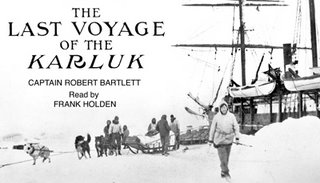
Excerpt: The Last Voyage of the Karluk by Captain Robert Bartlett (Captain Bob), setting: January 10, 1914


The following excerpt is from The Last Voyage of the Karluk An Epic of Death and Survival in the Arctic, 1913-1916 as related by her captain, Robert A. Bartlett and here set down by Ralph T. Hale (published in 1916 by Small, Maynard and Company, Inc.; unabridged audiobook edition narrated by Frank Holden published by Rattling Books).

...At five o'clock on the morning of the tenth I was awakended by a loud report like a rifle-shot. Then there came a tremor all through the ship. I was soon on deck. The watchman, who for that night was Brady, had already been overboard on the ice and I met him coming up the ice gangway to tell me what he had found. There was a small crack right at the stem of the ship, he said. I went there with him at once and found that the crack ran irregularly but in general northwesterly for about two hundred yards. At first it was very slight, although it was a clean and unmistakable break; in the course of half an hour, however, it grew to a foot in width and as the day wore on widened still more until it was two feet wide on an average.

By 10 A.M. there was a narrow lane of water off both bow and stern. The ship was now entirely free on the starboard side but still frozen fast in her ice-cradle on the port side ... The ship felt no pressure, only slight shocks, and her hull was still untouched, for the open ends of the pocket fended off the moving ice especially at the stern. It was clear to me, however, that as soon as the moving ice should grind or break off the points of these natural fenders there was a strong probability that the moving ice-sheet would draw nearer to the starboard side of the ship and, not unlike the jaws of a nut-cracker, squeeze her against the sheet in which she was frozen on the port side, particularly as the wind was attaining a velocity of forty-five miles an hour.

Everything indicated, therefore, that the time was near at hand when we should have to leave the ship. We must have things ready. I gave orders to get the snow off the deck and the skylights and the other walls of the cabin to lighten her. ...

At about half past seven in the evening I chanced to be standing near the engine-room door. The lamps were lighted. The labors of the day were over and now, after dinner, the men were playing cards or reading or sewing, as usual. All at once I heard a splitting, crashing sound below. I went down into the engine-room and found the chief engineer there. We could hear water rushing into the hold and by lantern-light could see it puring in at different places for a distance of ten feet along the port side....

I went on deck again and gave the order, "All hands abandon ship."

Tuesday, January 09, 2018

Excerpt: The Lure of the Labrador Wild: The classic story of Leonidas Hubbard by Dillon Wallace, setting: early January 1904


The following excerpt is from Dillon Wallace's classic story of the fateful canoe trip which Wallace, Leonidas Hubbard and George Elson made into the interior of Labrador in 1903 (The Lure of the Labrador Wild originally published in 1905 by Fleming H. Revell, New York) . In 2005 Rattling Books released an unabridged audiobook edition of The Lure of the Labrador Wild narrated by Jody Richardson.

As we pick up the story, Leonidas Hubbard lays dead in his tent in the Labrador wilderness and Wallace, slowly recovering from their ordeal, is planning to retrieve Hubbard's body and return with it to the US.

...Immediately upon my return to Northwest River, my feet began to trouble me again. Word was sent to Dr. Hardy, who, regarding it as a call of duty, arrived on December 31st. I very much regret to say, that in responding to the call, Dr. Hardy received a chill that hastened, if it did not cause, his death. After examining my feet upon his arrival, he advised me to return with him to Muddy Lake. So it was arranged that George, with Mackenzie's dogs and komatik, should drive Dr. Hardy and me to the Kenemish lumber camp twelve miles across Groswater Bay, where there was a patient that required attention, and that from there Hardy and I should go on to Muddy Lake with other dogs. Alas! the doctor never saw Muddy Lake again.

Before starting, I learned from Allen Goudie and Duncan MacLean, who came from the interior to spend New Year's Day that Grand Lake was frozen hard and an attempt might be made to bring out Hubbard's body. Accordingly, I engaged Duncan Maclean and Tom Blake, also a breed, to undertake the task with George, and to recover, so far as possible, the photographic films and other articles we had abandoned at Goose Camp and Lake Elson. Blake was the father of Mackenzie's housekeeper, and lived at the rapid at the eastern end of Grand Lake. As he had, at the request of friends, frequently prepared bodies for burial, it was arranged that he should head the expedition, while George acted as guide, and the agreement was that, weather permitting, the party should start inland on January 6th. A coffin, made by the carpenter at Kenemish, was all ready to receive the body when it should arrive at the post.

George was to have driven Dr. Hardy and me to Kenemish on January 3rd, but as there was a stiff wind blowing and the thermometer registered 40 degrees below zero, we postponed our departure untill the following day. The morning was clear, and the temperature was 34 below. The dogs, with a great howling and jumping, had hardly settled down to the slow trot which with only fair travelling is their habital gait, when we observed that the sky was clouding, and in an incredibly short time the first snowflakes of the gathering storm began to fall. Soon the snow was so thick that it shut us in as with a curtain, and eventually even old Aillik, our leader, was lost to view.

"Bear well t' th' east'ard, an' keep free o' th' bad ice; the's sure t' be bad ice handy t' th' Kenemish," had been Mark Blake's parting injunction. So George kept well to the eastward as, hour after hour, we forged our way on through the blinding, drifting snow. At length we came upon land, but what land we did not know. The storm had abated by this time, and a fresh komatik track was visible, which we proceeded to follow. On all sides of us ice was piled in heaps as high as a house. We had been travelling altogether about six hours, and the storm had ceased, when we came upon a tilt on the shore of a deep bay, and, close by it, a man making passes with a stick at a large wolf, which, apparently emboldened by hunger, was jumping and snarling about waiting for a chance to spring in upon him.

The noise of our approaching komatik caused the wolf to slink off, and then the man hurried to the tilt, reappeared with a rifle and shot the beast as it still prowled among the ice hills. He proved to be Uriah White, a trapper. Not at all excited by his adventure, he welcomed us to his tilt. In throwing off his mittens to fire his rifle at the wolf, he had exposed his naked hands to the bitter cold, and they had been frost bitten. While thawing out his hands at a safe distance from the stove, he informed us that he had been 'handy 'nuf to he (meaning the wolf) to see that he were a she."

... to be continued.

Sunday, January 07, 2018

On the Karluk with Captain Bob Jan 7 and 8, 1914


An excerpt from :  The Last Voyage of the Karluk by Captain Robert Bartlett

"...On the seventh and eighth the variable weather continued with occasional twilight of considerable intensity; the low barometer and high thermometer still prevailed. Our observations on the seventh, the last we were to take on shipboard, gave us our position as Lat. 72.11 N., Long. 174.36 W. ...."
(To be continued.)

This excerpt is from The Last Voyage of the Karluk An Epic of Death and Survival in the Arctic, 1913-1916 as related by her captain, Robert A. Bartlett and here set down by Ralph T. Hale (published in 1916 by Small, Maynard and Company, Inc.; unabridged audiobook edition narrated by Frank Holden published by Rattling Books).

Tuesday, January 02, 2018

January 2, 1914, from The Last Voyage of the Karluk by Captain Bob Bartlett


...During the night of New Year's Day we could hear, when we were below, a rumbling noise not unlike that which one often hears singing along the telegraph wires on a country road. The sound was inaudible from the deck. It was clear that there was tremendous pressure somewhere, though there were no visible indications of it in the vicinity of the ship. We were practically stationary. Apparently the great field of ice in which we had been zigzagging for so many months had finally brought up on the shore of Wrangell Island and was comparatively at rest, while the running ice outside this great field was still in active motion and tended to force the ice constantly in the direction of the island.

On Saturday, with a fresh north wind, in spite of which ship and ice still remained stationary, the rumbling noise could again be heard in the interior of the ship...."

(To be continued.)
This excerpt is from The Last Voyage of the Karluk An Epic of Death and Survival in the Arctic, 1913-1916 as related by her captain, Robert A. Bartlett and here set down by Ralph T. Hale (published in 1916 by Small, Maynard and Company, Inc.; unabridged audio edition narrated by Frank Holden published by Rattling Books).

Monday, January 01, 2018

New Year's Day on the Karluk: The Last Voyage of the Karluk by Captain Bob Bartlett, January 1, 1914


...We had our own New Year's celebration, though it was only a coincidence that it came on this particular day, for we had planned a football game on the ice when the weather should be good and the wind fairly light; New Year's Day happened to be the first good day for it.

The ball was made of seal-gut, cut into sections and sewed up, with surgeon's plaster over the seams. We blew it up with a pipe stem and plugged up the hole. To protect the ball we had a sealskin casing made to fit it; the result was a fairly good ball, constructed on the same principle as any college football.

It was Scotland vs. All-Nations; the game was association football, played on a field of regulation size laid out on young ice about a foot and half in thickness. At each end of the field were goal posts with the usual cross-bar.

Fireman Breddy was captain of All-Nations and Mr. Munro of Scotland. The Eskimo, though not well-versed in the game, played well. Keruk, clad as usual in dress and bloomers, was goal tender for All-Nations. Some of the players wore skin boots, other ordinary American shoes. I had forgotten a good deal about the association game but I refreshed my memory from the encyclopedia in the ship's library and armed with a mouth-organ in lieu of a whistle took my place as referee, umpire and time-keeper. I soon found, however, that the cold would make it too dangerous for me to use the 'whistle", for it would freeze to my lips and take the skin off, so I had to give my signals for play by word of mouth....
(To be continued.)

This excerpt is from The Last Voyage of the Karluk An Epic of Death and Survival in the Arctic, 1913-1916 as related by her captain, Robert A. Bartlett and here set down by Ralph T. Hale (published in 1916 by Small, Maynard and Company, Inc.; unabridged audiobook edition narrated by Frank Holden published by Rattling Books).

Friday, December 29, 2017

Spending Christmas with Captain Bob Bartlett Dec. 29, 1913

...As soon as it was light on the twenty-ninth I kept a sharp eye out for land; south by west, by the compass, I could see a blue cloud raised up on the horizon. According to the soundings we should have been nearer Wrangell Island than Herald Island; I was inclined to think that it was Herald Island, although working out our position with our chronometer readings gave us Herald Island sixty miles to the south. Afterwards I found out that our observations at this time were correct but that the soundings were not right on the chart. What deceived us more than anything else was the big mirage; Herald Island looked large and distorted for many days. Later in the day I went aloft to see if I could make out which island it really was but on account of the imperfect light I found it impossible to tell.

Some time during the night the ice cracked about a hundred yards from the ship and made an open ribbon of water ten inches wide; during the next day the young ice was cracking a good deal all around us....

This excerpt is from The Last Voyage of the Karluk An Epic of Death and Survival in the Arctic, 1913-1916 as related by her captain, Robert A. Bartlett and here set down by Ralph T. Hale (published in 1916 by Small, Maynard and Company, Inc.; unabridged audio edition narrated by Frank Holden published by Rattling Books). 

As the fifth night of Christmas approaches may there be no cracks in the ice around you.

Wednesday, December 27, 2017

Christmas Excerpt: The Last Voyage of the Karluk by Captain Bob Bartlett, setting: Dec. 26-27, 1913


"...On Friday the twenty-sixth a crack in the ice made from the waist of the ship towards the stern, running for about a hundred yards off the starboard bow. The crack did not open, but for the first time in our drift we felt a slight tremor on the ship. In about an hour we felt another slight tremor. I followed the crack for a hundred yards and then lost it. There was a fresh north-northeast wind which moderated as the day wore on but it looked as if we were in for some more bad weather, though the barometer was steady, and next day we began to get things ready to leave the ship at once, in case we should have to get out in a hurry. Everything was where we could lay our hands on it at once...."

This excerpt is from The Last Voyage of the Karluk An Epic of Death and Survival in the Arctic, 1913-1916 as related by her captain, Robert A. Bartlett and here set down by Ralph T. Hale (published in 1916 by Small, Maynard and Company, Inc.; unabridged audio edition narrated by Frank Holden published by Rattling Books).

Monday, December 25, 2017

Excerpt: Christmas Day with Captain Bob Bartlett on the Karluk, Dec 25, 1913 from The Last Voyage of the Karluk


The following excerpt is from The Last Voyage of the Karluk An Epic of Death and Survival in the Arctic, 1913-1916 as related by her captain, Robert A. Bartlett and here set down by Ralph T. Hale (published in 1916 by Small, Maynard and Company, Inc.; unabridged audio edition narrated by Frank Holden published by Rattling Books). 
"...At six o'clock on Christmas morning the second engineer and McKinlay started in decorating the cabin with the flags of the International Code and a fine lot of colored ribbon which Mr. Hadley had brought with him from Point Barrow for the trading he had hoped to do in Banks Land. Later in the morning I went around and distributed presents to the Eskimo. I gave each of the Eskimo men a hunting-knife and a watch and the Eskimo woman a cotton dress, stockings and underwear, talcum powder, soap, a looking-glass, a comb and brush and some ribbon, with a cotton dress for each of the little girls.

At eleven 0'clock the first event on our type-written programme began - the sports. This was the list:


D.G. S. Karluk. Xmas Day, 1913

The events of the sports programme arranged for the day will take place in the following order:
1. 100 yards sprint
2. Long jump (standing)
3. Long jump (running)
4. Sack race
5. High jump
Interval for refreshments
6. Three-legged race
7. Putting the weight
8. 50-yard burst
9. Hop, step and leap
10. Tug of war
11. Obstacle race
12. Wrestling
Proceedings will commence at 11 A.M. (Karluk time); dogs and bookmakers not allowed on the field.

The doctor was umpire and wore a paper rosette.

...Dinner as usual was at half past four. I confess that I felt homesick and thought of other Christmas dinners. It was my fourth Christmas in the Arctic; in 1898 I had been with Peary at Cape D'Urville on the Windward and in 1905 and 1908 at Cape Sheridan with the Roosevelt, but our situation now had far more elements of uncertainty in it than we hd felt on those occasions and in addition this time it was I who had the responsibility for the lives and fortunes of every man, woman and child in the party.

We sat down at 4:30 P.M. to a menu laid out and typewritten by McKinlay:


"Such a bustle ensued"
Mixed Pickles Sweet Pickles
Oyster Soup
Lobster
Bear Steak
Ox Tongue
Potatoes Green Peas
Asparagus and Cream Sauce
Mince Pie Plum Pudding
Mixed Nuts
Tea Cake
Straswberries
"God Bless You, Merry Gentlemen;
May Nothing You Dismay!'

Murray produced a cake which had been given in Victoria to cut for this particular occasion and which he had kept carefully secreted. Dinner, which was a great credit to Bob, the cook, was followed by cigars and cigarettes and a concert on the Victrola which had been presented to the ship by Sir Richard McBride. We had records that played both classical and popular music, vocal and instrumental, and we kept this up with singing, to a late hour. Malloch wrote a Christmas letter of many pages to his father, a letter which, alas, was destined never to be delivered.... (to be continued)"

The unabridged audiobook recording of The Last Voyage of the Karluk by Captain Robert Bartlett, narrated by Frank Holden is available from Rattling Books.

Thursday, December 21, 2017

Excerpt: The Last Voyage of the Karluk by Captain Bob Bartlett, setting: Dec. 18-23, 1913

The following excerpt is from The Last Voyage of the Karluk An Epic of Death and Survival in the Arctic, 1913-1916 as related by her captain, Robert A. Bartlett and here set down by Ralph T. Hale (published in 1916 by Small, Maynard and Company, Inc.; unabridged audio edition narrated by Frank Holden published by Rattling Books).

"...Murray lost his dredge again on the eighteenth when it caught on the ice and parted the line; the chief engineer started work at once on another.

December 21 was the Arctic midnight, the day of days in the Arctic, the day that we all looked forward to, for now the sun was coming towards us every day, and every day the daylight would lengthen. We were not, of course, getting real daylight but at midday we got a kind of twilight that was good enough to get about by, out of doors. Mr. Hadley and I experimented with the acetylene lights but found that outside of the ship they would not work because the water froze.

On the twenty-second much of the twilight time was used in clearing away the huge banks of snow that had drifted about the ship. The chess tournament was decided on that day. The men had been playing it for a good while and now the winner of the most games received the first prize, a box of fifty cigars, and the next man the second prize, a box of twenty-five cigars. Mamen took the first prize and the mate, Mr. Anderson, the second.

The dogs, which we had been keeping all together in the box-house, broke their chains on the twenty-third, and some of them got into a fight; our best, Jack, was so badly bitten that he could not walk. I took him on board and down into the carperter's shop where Mr. Hadley sewed up his wounds with surgical needle and silk cord. Poor Jack was in bad shape and at first refused all food. He received constant attention from Mr. Hadley but could not bear a harness until the latter part of February. The fight in which he was hurt warned us that we must not keep too many dogs together, so I had the Eskimo build several snow kennels in a large snowbank near the ship. They sprinkled ashes on the floor of the kennels and chained up the nine most quarrelsome dogs, each in his separate kennel.

With the approach of Christmas all hands began to make plans for the proper celebration of that good old holiday. The spirits of the whole party were excellent; now that they were in the neighborhood of the place where Santa Claus came from they seemed determined to observe the day in a manner worthy of the jolly old saint..."

Saturday, December 16, 2006

Excerpt: The Last Voyage of the Karluk by Captain Bob Bartlett, setting: Dec. 16, 1913

... On the sixteenth I had the Eskimo dig out the seal meat which we had kept in the "ice-houses" near the ship and put it on deck, so that we could have it handy in case the ice broke up around the ship. Furthermore, I wanted to see how much we had accumulated. I found that we had forty-one seal, about 1600 pounds, enough to last twenty-five people sixty-seven days. Not every one on board liked seal meat but all could eat it. I had Mamen at work these days making up a list of things required in case I went on another Arctic drift some time...
This excerpt is from The Last Voyage of the Karluk An Epic of Death and Survival in the Arctic, 1913-1916 as related by her captain, Robert A. Bartlett and here set down by Ralph T. Hale (published in 1916 by Small, Maynard and Company, Inc.; unabridged audio edition narrated by Frank Holden published by Rattling Books).

Thursday, December 07, 2006

Excerpt from The Last Voyage of the Karluk by Captain Robert Bartlett (early December, 1913)


This excerpt is from The Last Voyage of the Karluk An Epic of Death and Survival in the Arctic, 1913-1916 As related by her captain, Robert A. Bartlett and here set down by Ralph T. Hale (published in 1916 by Small, Maynard and Company, Inc.; unabridged audio edition narrated by Frank Holden published by Rattling Books in 2005).

The Karluk has been frozen into the ice of the Arctic Ocean. She and her crew who are still living aboard are drifting with the current.

The first few days of December were cold and stormy, with very high winds. I made up my mind that we were in the place where all the bad weather was manufactured, to be passed along to Medicine Hat and thence distributed to Chicago and Boston and points south. We got a little twilight from ten to two on pleasant days, so that the men could see to work out of doors. The health of the party throughout our drift was excellent. Every one had plenty of vigourous, outdoor exercise and slept soundly, though the incessant howling of the wind was not always conducive to a feeling of carefree contentment.

There was considerable pressure early in the month at a point about a mile from the ship, which tossed the ice into rafters, but we did not feel it on board. On the tenth a ribbon of water about a foot wide showed in the ice about two hundred yards from the ship, opening and closing off and on for several days. The temperature was getting pretty cold now, down in the minus thirties, yet the air was clear much of the time and we were not uncomfortable out of doors, even in American clothes....

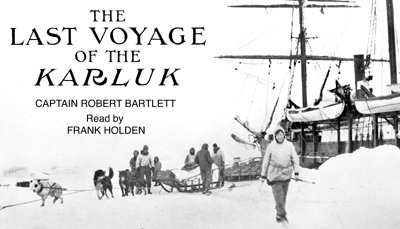
You can listen to an excerpt of Frank Holden narrating Rattling Books audio edition of The Last Voyage of the Karluk by clicking here.