Showing posts with label Captain Bob Bartlett. Show all posts

Thursday, March 22, 2018

Excerpt: The Last Voyage of the Karluk by Captain Bob Bartlett, setting: March 12, 1914


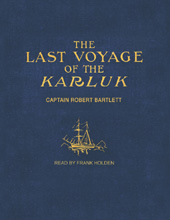
In this excerpt we continue The Last Voyage of the Karluk: An Epic of Death and Survival in the Arctic, 1913-1916 as related by her captain, Robert A. Bartlett and here set down by Ralph T. Hale (published in 1916 by Small, Maynard and Company, Inc.; unabridged audiobook edition narrated by Frank Holden published by Rattling Books).

“March 12 we got away again at dawn. McKinlay, Mamen, Kataktovick, Kerdrillo, and his family and I went ahead of the others, with lightly loaded sledges, and, on account of improved ice conditions, made such good progress that at one P.M. we landed on Icy Spit, on the northeast side of Wrangell Island. It is perhaps easier to imagine than to describe our feelings of relief at being once again on terra firma, after two months of drifting and traveling on the ice. We had had a hard road to travel much of the way from Shipwreck Camp, but fortunately, since the big storm in the days following the departure of the advance party, we had had continuously fine weather, with good daylight and exhilarating temperatures in the minus forties and fifties.

As soon as we landed we began building an igloo. There was plenty of driftwood scattered all about and Keruk gathered up a lot of it and built a fire, so that by the time the first of our three igloos was built she had some tea for us and the rest of the party who, coming along easily with light loads over our trail, arrived an hour and a half after we did. We were overjoyed to find the driftwood for, although we were pretty sure of finding it, yet we were a little dubious and it was a great relief to my mind to know that fuel was assured.

We could see a good deal of the island from the spit, which made out from land some distance into the ocean. Waring Point lay far to the east of us and Evans Point to the west. The geographical names on Wrangell Island were derived from the names of the officers of the U.S.S. Rodgers who explored the island in 1881. On a clear day like this it was not unusual to be able to see for seventy miles. The northeast side of the island, on which we now were, sent several low sandy spits out from the land, thus forming lagoons which of course were covered with ice. Near the coast were low mountains and valleys, with higher peaks in the interior beyond. Here and there on the beach were dead trees that had drifted ashore, with the roots sticking up into the air; we also found planks and other lumber. Everything was snow clad and white, only a degree less cheerless than the frozen ocean itself.

The next day Munro, Chafe, Breddy and Williams went back with all the dogs and sledges to the last camp on the ice, fifteen miles from our landing-place, and brought in all the supplies we had left there. While they were gone I sent Kerdrillo nine miles across the lagoon to Berry Spit, to see if he could find any traces of the mate’s party or the Mackay party. He took his rifle with him to look for game. When he came back at nightfall, he reported that he had seen no traces of either party and only one bear track and one fox track. This was an indication that there was small chance of getting a bear on or near the island, because there were no seal holes within twenty-five miles from land; we had seen some near the big rafter, about forty miles out. Later in the season, as the ice broke up nearer the land, the seal would work in shore and of course the bears would follow. I asked Kerdrillo what he thought the chances were of there being any caribou or reindeer on the island. It is not an uncommon thing to find caribou on islands in Hudson Strait, which have drifted on the ice from the mainland, and there were, I knew, both these animals in plenty on the Siberian coast. I wondered, too, whether there might not be Arctic hare on the island. Kerdrillo said he thought there was so much snow that caribou and reindeer would be unlikely to staty where it would be so difficult for them to get food and he did not believe any were to be found.

The next day, to verify his opinion, I sent him out again, giving him tea and pemmican, so that he could have a full day’s march and make a reconnaissance into the interior. About dark he returned and reported that he had seen no traces of caribou, reindeer or hare and very few signs of foxes. Later on , however, h thought ptarmigan would visit the island. He had seen one bear track, which he thought was about three days old, probably of the bear whose tracks he had seen on the previous day.

The story is told of a student who, when asked to name five Arctic animals, replied, “Three polar bears and two seal.” If these varieties were to be all we should find on Wrangell island, we should still be able to sustain life, if only we could get enough of them. I should have liked, however, to know that caribou and reindeer, too, could be had for the shooting.

We now made a snow shelter and started in on the fourteenth to dry out our boots and stockings; we had plenty of firewood. Keruk looked after this work. Maurer’s and Malloch’s feet still troubled them and Mamen’s knee was a constant cause of suffering, so that I was glad that they could now have an opportunity to rest. From the moment of our departure from Shipwreck Camp we had been constantly on the move during every minute of the daylight. The weather, though cold, had been exceptionally fine and clear; in fact we had not lost an hour on account of bad weather and had been inconvenienced for only one night by open water. As a consequence all hands were in need of a little rest. The dogs, too, were in a reduced condition, for though they had had plenty to eat they had worked very hard and I wanted them to get what rest they could.”

To be continued.

Monday, March 19, 2018

Excerpt: The Last Voyage of the Karluk by Captain Bob Bartlett, setting: March 10 (ish), 1914


In this excerpt we continue The Last Voyage of the Karluk An Epic of Death and Survival in the Arctic, 1913-1916 as related by her captain, Robert A. Bartlett and here set down by Ralph T. Hale (published in 1916 by Small, Maynard and Company, Inc.; unabridged audiobook edition narrated by Frank Holden published by Rattling Books).

**********************

The next morning, therefore, I sent McKinlay, Hadley and Mamen back to bring up the bear meat. The rest of us sledged supplies along the shoreward way, Kataktovick and I walking on ahead to blaze the trail. We had a continuation of the fine weather and low temperature. I suppose it was about forty or fifty below zero. We sledged a good part of the supplies along to the new camp on the big floe and built igloos there. The next day we continued the work, Kataktovick picking the trail. At first it was rough going but after a time it became a little better and we moved all our supplies ten miles nearer the land, returning to the igloos on the big floe for the night. We found that at one of the temporary caches along the way two bears had destroyed a case of coal oil and scattered two tins of biscuit over the ice.
It was hard luck, after getting the oil so near the island, to have bears to contend with in addition to the elements, especially as our dogs were not trained to follow a bear, so that there was no use trying to go after them. A polar bear has a very acute sense of smell and can scent a human being in plenty of time to get away from him, and as a bear can go faster than a man it can escape easily, unless the hunter has dogs trained from puppyhood to follow a bear and round him up, the way the dogs of Greenland can do. Of the bears that the McKinlay party shot the meat was simply cut off the bones, to have no useless weight to carry and some of if was cached on the ice, with the skins, and the rest brought with us. We expected to be able to get it later on but never did because we did not go back over the trail again, and we expected to get more bears on our way to the island.

On the tenth we kept up the task of sledging the supplies forward. We worked from daylight to dark, some with pickaxes, others with sledges with light loads, for the going was rough. The Eskimo built the igloos and by night we had all our supplies up, Munro, Mamen and myself getting in with the last load just at dark.

The going was was bad nearly all the way along here. Kataktovick and I were off at the first crack of dawn picking the trail for the others to follow with their pickaxes and their lightly loaded sledges. It was necessary for us to make fairly good loads, for a white man can not handle a sledge as deftly as an Eskimo can and we had not enough Eskimo to drive all the sledges even if they had been free from the work of trail-making and building igloos.

We made about seven miles during the day. Sometimes we had to get the sledges up on a ridge fifty feet high with an almost sheer drop on the other side. When we came to such rough places we would harness all the dogs to a sledge and all of us who could get a hand on it would help push the sledge. When we got the sledge up to the top we would run a rope from it to another sledge down below and as the first sledge went down the other side it would pull the second sledge up.


Friday, March 16, 2018

Excerpt: The Last Voyage of the Karluk by Captain Robert Bartlett (setting: March 5-9 1914)


The following excerpt is from The Last Voyage of the Karluk An Epic of Death and Survival in the Arctic, 1913-1916 as related by her captain, Robert A. Bartlett and here set down by Ralph T. Hale (published in 1916 by Small, Maynard and Company, Inc.; unabridged audiobook edition narrated by Frank Holden published by Rattling Books).


March 4, at about four P.M., we finished working through the rafter and came out on the smoother ice on its landward side. Mamen, Kataktovick and I spent the day sledging supplies across from the camp on the farther side and when the road was finished we all went back for the last load. It was not until eight P.M. that we had all our supplies at the new camp and we had to do the last of the work in the dark; the Eskimo had built three igloos while we were sledging. It had taken us four days to get across a distance of three miles. From the shore side it was easy to see the basis of the formation of such rafters. A storm causes the moving ice to smash against and slide over the still ice and the pressure of the “irresistible force meeting the immovable body” throws the ice into fantastic, mountainous formations that are as weird as that astounding picture of Chaos before the Creation that used to ornament the first volume of Ridpath’s “History of the World.”

At daylight on March 5 I sent Munro and a party back across the three miles of raftered ice to meet the McKinlay party who were about due back from Shipwreck Camp. Munro and the others could guide and help them across the difficult road we had made. While they were gone I took Kataktovick and laid out a trail towards the land for the next day’s march. Now for the first time since we left Shipwreck Camp, we got a view of Wrangell Island; it was high and we seemed almost under it. The air was exceptionally clear and the land looked close to us.

Munro and his party did not get back until long after dark. They had reached our last camp across the raftered ice and not finding McKinlay and the others there had continued on the back trail, hoping to meet them. They went on as far as they could go without being compelled to stay out all night, and then came back, because they had no sleeping-robes and would have had a poor night of it, besides being obliged to build an igloo. They were wise in knowing when they had gone far enough; Munro showed his usual good judgment.

Our progress in to the island was retarded by the necessity of keeping along with us as large a quantity of supplies as possible. This meant relaying supplies, because the going was bad and made sledging difficult, with the small number of dogs we had. On the sixth, as soon as the first streak of light appeared, I sent Munro and his party back again to meet the McKinlay party, while I took Kataktovick and Kerdrillo and went ahead towards the island, road-making with our pickaxes. Munro had told me that when he first saw the three mile belt of raftered ice, he never thought for a moment that we should ever get through it. Any novice certainly had a right to feel discouraged; it was as tough a job as I ever tackled. We now picked our way – I might almost say pick-axed our way – across the ice from our last camp for a distance of seven miles until we came to a large, heavy floe, which would make a good place for a new camp; here we threw off the light loads which we had brought on two of the Peary sledges and returned to camp. At half past four the McKinlay party came in, convoyed by Munro and his party. McKinlay and his companions had gone clear back to Shipwreck Camp and brought in six cases of dog pemmican, sixteen cases of Hudson’s Bay pemmican, thirty gallons of gasoline, and some hatchets and snow-knives. They had left at the first camp from Shipwreck Camp four cases of Underwood dog pemmican and ten tins of Hudson’s Bay pemmican, for they already had too heavy loads to bring them.

Wednesday, January 10, 2018

Excerpt: The Last Voyage of the Karluk by Captain Robert Bartlett (Captain Bob), setting: January 10, 1914


The following excerpt is from The Last Voyage of the Karluk An Epic of Death and Survival in the Arctic, 1913-1916 as related by her captain, Robert A. Bartlett and here set down by Ralph T. Hale (published in 1916 by Small, Maynard and Company, Inc.; unabridged audiobook edition narrated by Frank Holden published by Rattling Books).

...At five o'clock on the morning of the tenth I was awakended by a loud report like a rifle-shot. Then there came a tremor all through the ship. I was soon on deck. The watchman, who for that night was Brady, had already been overboard on the ice and I met him coming up the ice gangway to tell me what he had found. There was a small crack right at the stem of the ship, he said. I went there with him at once and found that the crack ran irregularly but in general northwesterly for about two hundred yards. At first it was very slight, although it was a clean and unmistakable break; in the course of half an hour, however, it grew to a foot in width and as the day wore on widened still more until it was two feet wide on an average.

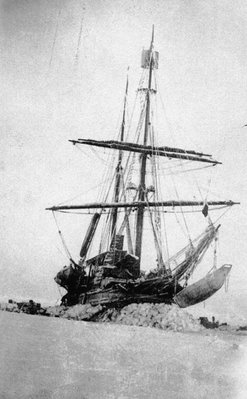
By 10 A.M. there was a narrow lane of water off both bow and stern. The ship was now entirely free on the starboard side but still frozen fast in her ice-cradle on the port side ... The ship felt no pressure, only slight shocks, and her hull was still untouched, for the open ends of the pocket fended off the moving ice especially at the stern. It was clear to me, however, that as soon as the moving ice should grind or break off the points of these natural fenders there was a strong probability that the moving ice-sheet would draw nearer to the starboard side of the ship and, not unlike the jaws of a nut-cracker, squeeze her against the sheet in which she was frozen on the port side, particularly as the wind was attaining a velocity of forty-five miles an hour.

Everything indicated, therefore, that the time was near at hand when we should have to leave the ship. We must have things ready. I gave orders to get the snow off the deck and the skylights and the other walls of the cabin to lighten her. ...

At about half past seven in the evening I chanced to be standing near the engine-room door. The lamps were lighted. The labors of the day were over and now, after dinner, the men were playing cards or reading or sewing, as usual. All at once I heard a splitting, crashing sound below. I went down into the engine-room and found the chief engineer there. We could hear water rushing into the hold and by lantern-light could see it puring in at different places for a distance of ten feet along the port side....

I went on deck again and gave the order, "All hands abandon ship."

Sunday, January 07, 2018

On the Karluk with Captain Bob Jan 7 and 8, 1914


An excerpt from :  The Last Voyage of the Karluk by Captain Robert Bartlett

"...On the seventh and eighth the variable weather continued with occasional twilight of considerable intensity; the low barometer and high thermometer still prevailed. Our observations on the seventh, the last we were to take on shipboard, gave us our position as Lat. 72.11 N., Long. 174.36 W. ...."
(To be continued.)

This excerpt is from The Last Voyage of the Karluk An Epic of Death and Survival in the Arctic, 1913-1916 as related by her captain, Robert A. Bartlett and here set down by Ralph T. Hale (published in 1916 by Small, Maynard and Company, Inc.; unabridged audiobook edition narrated by Frank Holden published by Rattling Books).

Tuesday, January 02, 2018

January 2, 1914, from The Last Voyage of the Karluk by Captain Bob Bartlett


...During the night of New Year's Day we could hear, when we were below, a rumbling noise not unlike that which one often hears singing along the telegraph wires on a country road. The sound was inaudible from the deck. It was clear that there was tremendous pressure somewhere, though there were no visible indications of it in the vicinity of the ship. We were practically stationary. Apparently the great field of ice in which we had been zigzagging for so many months had finally brought up on the shore of Wrangell Island and was comparatively at rest, while the running ice outside this great field was still in active motion and tended to force the ice constantly in the direction of the island.

On Saturday, with a fresh north wind, in spite of which ship and ice still remained stationary, the rumbling noise could again be heard in the interior of the ship...."

(To be continued.)
This excerpt is from The Last Voyage of the Karluk An Epic of Death and Survival in the Arctic, 1913-1916 as related by her captain, Robert A. Bartlett and here set down by Ralph T. Hale (published in 1916 by Small, Maynard and Company, Inc.; unabridged audio edition narrated by Frank Holden published by Rattling Books).

Monday, January 01, 2018

New Year's Day on the Karluk: The Last Voyage of the Karluk by Captain Bob Bartlett, January 1, 1914


...We had our own New Year's celebration, though it was only a coincidence that it came on this particular day, for we had planned a football game on the ice when the weather should be good and the wind fairly light; New Year's Day happened to be the first good day for it.

The ball was made of seal-gut, cut into sections and sewed up, with surgeon's plaster over the seams. We blew it up with a pipe stem and plugged up the hole. To protect the ball we had a sealskin casing made to fit it; the result was a fairly good ball, constructed on the same principle as any college football.

It was Scotland vs. All-Nations; the game was association football, played on a field of regulation size laid out on young ice about a foot and half in thickness. At each end of the field were goal posts with the usual cross-bar.

Fireman Breddy was captain of All-Nations and Mr. Munro of Scotland. The Eskimo, though not well-versed in the game, played well. Keruk, clad as usual in dress and bloomers, was goal tender for All-Nations. Some of the players wore skin boots, other ordinary American shoes. I had forgotten a good deal about the association game but I refreshed my memory from the encyclopedia in the ship's library and armed with a mouth-organ in lieu of a whistle took my place as referee, umpire and time-keeper. I soon found, however, that the cold would make it too dangerous for me to use the 'whistle", for it would freeze to my lips and take the skin off, so I had to give my signals for play by word of mouth....
(To be continued.)

This excerpt is from The Last Voyage of the Karluk An Epic of Death and Survival in the Arctic, 1913-1916 as related by her captain, Robert A. Bartlett and here set down by Ralph T. Hale (published in 1916 by Small, Maynard and Company, Inc.; unabridged audiobook edition narrated by Frank Holden published by Rattling Books).

Friday, December 29, 2017

Spending Christmas with Captain Bob Bartlett Dec. 29, 1913

...As soon as it was light on the twenty-ninth I kept a sharp eye out for land; south by west, by the compass, I could see a blue cloud raised up on the horizon. According to the soundings we should have been nearer Wrangell Island than Herald Island; I was inclined to think that it was Herald Island, although working out our position with our chronometer readings gave us Herald Island sixty miles to the south. Afterwards I found out that our observations at this time were correct but that the soundings were not right on the chart. What deceived us more than anything else was the big mirage; Herald Island looked large and distorted for many days. Later in the day I went aloft to see if I could make out which island it really was but on account of the imperfect light I found it impossible to tell.

Some time during the night the ice cracked about a hundred yards from the ship and made an open ribbon of water ten inches wide; during the next day the young ice was cracking a good deal all around us....

This excerpt is from The Last Voyage of the Karluk An Epic of Death and Survival in the Arctic, 1913-1916 as related by her captain, Robert A. Bartlett and here set down by Ralph T. Hale (published in 1916 by Small, Maynard and Company, Inc.; unabridged audio edition narrated by Frank Holden published by Rattling Books). 

As the fifth night of Christmas approaches may there be no cracks in the ice around you.

Wednesday, December 27, 2017

Christmas Excerpt: The Last Voyage of the Karluk by Captain Bob Bartlett, setting: Dec. 26-27, 1913


"...On Friday the twenty-sixth a crack in the ice made from the waist of the ship towards the stern, running for about a hundred yards off the starboard bow. The crack did not open, but for the first time in our drift we felt a slight tremor on the ship. In about an hour we felt another slight tremor. I followed the crack for a hundred yards and then lost it. There was a fresh north-northeast wind which moderated as the day wore on but it looked as if we were in for some more bad weather, though the barometer was steady, and next day we began to get things ready to leave the ship at once, in case we should have to get out in a hurry. Everything was where we could lay our hands on it at once...."

This excerpt is from The Last Voyage of the Karluk An Epic of Death and Survival in the Arctic, 1913-1916 as related by her captain, Robert A. Bartlett and here set down by Ralph T. Hale (published in 1916 by Small, Maynard and Company, Inc.; unabridged audio edition narrated by Frank Holden published by Rattling Books).

Monday, December 25, 2017

Excerpt: Christmas Day with Captain Bob Bartlett on the Karluk, Dec 25, 1913 from The Last Voyage of the Karluk


The following excerpt is from The Last Voyage of the Karluk An Epic of Death and Survival in the Arctic, 1913-1916 as related by her captain, Robert A. Bartlett and here set down by Ralph T. Hale (published in 1916 by Small, Maynard and Company, Inc.; unabridged audio edition narrated by Frank Holden published by Rattling Books). 
"...At six o'clock on Christmas morning the second engineer and McKinlay started in decorating the cabin with the flags of the International Code and a fine lot of colored ribbon which Mr. Hadley had brought with him from Point Barrow for the trading he had hoped to do in Banks Land. Later in the morning I went around and distributed presents to the Eskimo. I gave each of the Eskimo men a hunting-knife and a watch and the Eskimo woman a cotton dress, stockings and underwear, talcum powder, soap, a looking-glass, a comb and brush and some ribbon, with a cotton dress for each of the little girls.

At eleven 0'clock the first event on our type-written programme began - the sports. This was the list:


D.G. S. Karluk. Xmas Day, 1913

The events of the sports programme arranged for the day will take place in the following order:
1. 100 yards sprint
2. Long jump (standing)
3. Long jump (running)
4. Sack race
5. High jump
Interval for refreshments
6. Three-legged race
7. Putting the weight
8. 50-yard burst
9. Hop, step and leap
10. Tug of war
11. Obstacle race
12. Wrestling
Proceedings will commence at 11 A.M. (Karluk time); dogs and bookmakers not allowed on the field.

The doctor was umpire and wore a paper rosette.

...Dinner as usual was at half past four. I confess that I felt homesick and thought of other Christmas dinners. It was my fourth Christmas in the Arctic; in 1898 I had been with Peary at Cape D'Urville on the Windward and in 1905 and 1908 at Cape Sheridan with the Roosevelt, but our situation now had far more elements of uncertainty in it than we hd felt on those occasions and in addition this time it was I who had the responsibility for the lives and fortunes of every man, woman and child in the party.

We sat down at 4:30 P.M. to a menu laid out and typewritten by McKinlay:


"Such a bustle ensued"
Mixed Pickles Sweet Pickles
Oyster Soup
Lobster
Bear Steak
Ox Tongue
Potatoes Green Peas
Asparagus and Cream Sauce
Mince Pie Plum Pudding
Mixed Nuts
Tea Cake
Straswberries
"God Bless You, Merry Gentlemen;
May Nothing You Dismay!'

Murray produced a cake which had been given in Victoria to cut for this particular occasion and which he had kept carefully secreted. Dinner, which was a great credit to Bob, the cook, was followed by cigars and cigarettes and a concert on the Victrola which had been presented to the ship by Sir Richard McBride. We had records that played both classical and popular music, vocal and instrumental, and we kept this up with singing, to a late hour. Malloch wrote a Christmas letter of many pages to his father, a letter which, alas, was destined never to be delivered.... (to be continued)"

The unabridged audiobook recording of The Last Voyage of the Karluk by Captain Robert Bartlett, narrated by Frank Holden is available from Rattling Books.

Thursday, December 21, 2017

Excerpt: The Last Voyage of the Karluk by Captain Bob Bartlett, setting: Dec. 18-23, 1913

The following excerpt is from The Last Voyage of the Karluk An Epic of Death and Survival in the Arctic, 1913-1916 as related by her captain, Robert A. Bartlett and here set down by Ralph T. Hale (published in 1916 by Small, Maynard and Company, Inc.; unabridged audio edition narrated by Frank Holden published by Rattling Books).

"...Murray lost his dredge again on the eighteenth when it caught on the ice and parted the line; the chief engineer started work at once on another.

December 21 was the Arctic midnight, the day of days in the Arctic, the day that we all looked forward to, for now the sun was coming towards us every day, and every day the daylight would lengthen. We were not, of course, getting real daylight but at midday we got a kind of twilight that was good enough to get about by, out of doors. Mr. Hadley and I experimented with the acetylene lights but found that outside of the ship they would not work because the water froze.

On the twenty-second much of the twilight time was used in clearing away the huge banks of snow that had drifted about the ship. The chess tournament was decided on that day. The men had been playing it for a good while and now the winner of the most games received the first prize, a box of fifty cigars, and the next man the second prize, a box of twenty-five cigars. Mamen took the first prize and the mate, Mr. Anderson, the second.

The dogs, which we had been keeping all together in the box-house, broke their chains on the twenty-third, and some of them got into a fight; our best, Jack, was so badly bitten that he could not walk. I took him on board and down into the carperter's shop where Mr. Hadley sewed up his wounds with surgical needle and silk cord. Poor Jack was in bad shape and at first refused all food. He received constant attention from Mr. Hadley but could not bear a harness until the latter part of February. The fight in which he was hurt warned us that we must not keep too many dogs together, so I had the Eskimo build several snow kennels in a large snowbank near the ship. They sprinkled ashes on the floor of the kennels and chained up the nine most quarrelsome dogs, each in his separate kennel.

With the approach of Christmas all hands began to make plans for the proper celebration of that good old holiday. The spirits of the whole party were excellent; now that they were in the neighborhood of the place where Santa Claus came from they seemed determined to observe the day in a manner worthy of the jolly old saint..."

Tuesday, January 18, 2011

Today In History . . .

On January 18, 1912, English explorer Robert F. Scott and his expedition reached the South Pole.
Exciting stuff, but there was one problem. Norwegian explorer Roald Amundsen had gotten there before him.

If polar exploration is your thing, listen to an excerpt from Rattling Books' The Last Voyage of the Karluk, Captain Robert Bartlett's account of being stranded in the far north during an early twentieth-century polar expedition. Narrated by Frank Holden, it's a spine-tingling story with many and various elements, including small children, dogs and Chopin's "Funeral March."


This unabridged audio book is available as an MP3 CD or an MP3 digital download.

Rattling Books publishes Canadian audiobooks from Newfoundland and Labrador.


Wednesday, August 22, 2007

Captain Bob Bartlett in The Independent

Excerpted from a Review of The Log of Bob Bartlett
published by Flanker Press, 2006

The Independent
Friday, May 25, 2007
by Mark Callanan

Robert Abram Bartlett is often hailed as one of Newfoundland’s finest sons. Even in his own lifetime, the sea captain, adventurer, author and lecturer attained something of a mythic stature. His survival of multiple shipwrecks (twelve in all), his role in Robert E. Peary’s multiple attempts to reach the North Pole, and the rescue of his crew after the sinking of Vilhjalmur Stefansson’s flagship Karluk (which involved a seven-hundred mile trek across both frozen sea and Siberian coastline for help) made him a darling of the New York social circuit; he often sat as guest of honour at the tables of the rich.

Despite Michael Winter’s iconoclastic portrayal of Captain Bob in his 2004 novel The Big Why (Winter has Bartlett drunkenly confess to the narrator, American artist Rockwell Kent, that he “fisted” a man during a sexual encounter that took place after a visit to a gay fetishist’s club in New York City), it is the image of the rock solid, crag-faced sea captain that prevails. Reading The Log of Bob Bartlett, the captain’s own account of his life on the sea, it is easy to see why he has captured the collective imagination for so long.

Robert Abram Bartlett was born in Brigus, Conception Bay, on August 15, 1875 to William and Mary (Leamon) Bartlett, both Wesleyan Methodists. It was his mother’s intention that her eldest son become a Methodist minister, but the “deep religious atmosphere” of Bartlett’s childhood home was not enough to keep the young man from the nautical life. “Against all visible,” he writes, “there was the dual influence ever at work beneath my boyish exterior: the blood in my healthy young veins and the unending stories of my seafaring relations […] that fell upon my eager ears.”

Though Bartlett dedicates two chapters of this current volume to the Karluk disaster, it is more fully dealt with in The Last Voyage of the Karluk (1916; also reprinted by Flanker Press as a sister volume to The Log). Bartlett’s take on the Peary expeditions to the North Pole is of greater interest here. Of the Cook-Peary polar controversy, he writes: “I […] knew how utterly impossible it was for Cook to have crossed 1,000 miles of Polar Sea ice without supporting parties; especially since he had taken the Ellesmere Land route, which meant hundreds of miles of stiff travel before he even set foot on the Polar Sea.” Yet he stops short of denouncing Cook as a liar [...]

******************

Captain Bob Bartlett's The Last Voyage of the Karluk is also available in an unabridged audio edition from Rattling Books; an unabridged audio edition of Michael Winter's The Big Why is forthcoming from Rattling Books in the fall of 2007.

Saturday, December 16, 2006

Excerpt: The Last Voyage of the Karluk by Captain Bob Bartlett, setting: Dec. 16, 1913

... On the sixteenth I had the Eskimo dig out the seal meat which we had kept in the "ice-houses" near the ship and put it on deck, so that we could have it handy in case the ice broke up around the ship. Furthermore, I wanted to see how much we had accumulated. I found that we had forty-one seal, about 1600 pounds, enough to last twenty-five people sixty-seven days. Not every one on board liked seal meat but all could eat it. I had Mamen at work these days making up a list of things required in case I went on another Arctic drift some time...
This excerpt is from The Last Voyage of the Karluk An Epic of Death and Survival in the Arctic, 1913-1916 as related by her captain, Robert A. Bartlett and here set down by Ralph T. Hale (published in 1916 by Small, Maynard and Company, Inc.; unabridged audio edition narrated by Frank Holden published by Rattling Books).

Thursday, December 07, 2006

Excerpt from The Last Voyage of the Karluk by Captain Robert Bartlett (early December, 1913)


This excerpt is from The Last Voyage of the Karluk An Epic of Death and Survival in the Arctic, 1913-1916 As related by her captain, Robert A. Bartlett and here set down by Ralph T. Hale (published in 1916 by Small, Maynard and Company, Inc.; unabridged audio edition narrated by Frank Holden published by Rattling Books in 2005).

The Karluk has been frozen into the ice of the Arctic Ocean. She and her crew who are still living aboard are drifting with the current.

The first few days of December were cold and stormy, with very high winds. I made up my mind that we were in the place where all the bad weather was manufactured, to be passed along to Medicine Hat and thence distributed to Chicago and Boston and points south. We got a little twilight from ten to two on pleasant days, so that the men could see to work out of doors. The health of the party throughout our drift was excellent. Every one had plenty of vigourous, outdoor exercise and slept soundly, though the incessant howling of the wind was not always conducive to a feeling of carefree contentment.

There was considerable pressure early in the month at a point about a mile from the ship, which tossed the ice into rafters, but we did not feel it on board. On the tenth a ribbon of water about a foot wide showed in the ice about two hundred yards from the ship, opening and closing off and on for several days. The temperature was getting pretty cold now, down in the minus thirties, yet the air was clear much of the time and we were not uncomfortable out of doors, even in American clothes....

You can listen to an excerpt of Frank Holden narrating Rattling Books audio edition of The Last Voyage of the Karluk by clicking here.